
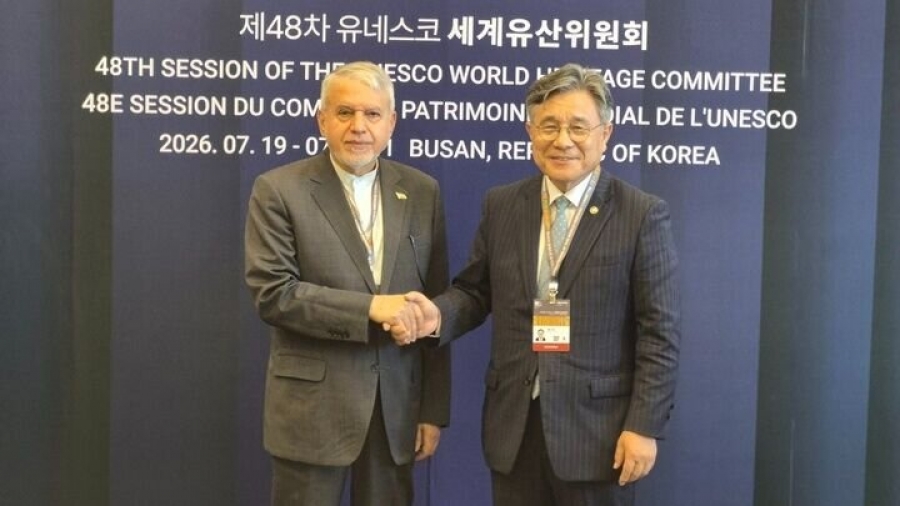
He also invited Ho Min to visit Iran and said the country's Cultural Heritage Research Institute, with nearly a century of experience, was ready to cooperate with its South Korean counterparts through joint scientific projects and exchanges.
Salehi-Amiri said Iran was prioritizing digital transformation in the heritage sector, including smart technologies, three-dimensional documentation of historical sites and the use of artificial intelligence to introduce Iran's cultural heritage to international audiences.
The two sides also discussed cooperation in conservation, restoration, specialist training, digitalization, artificial intelligence, joint exhibitions and professional exchanges, according to the ministry.
Also at the meeting, Ali Darabi, deputy minister for cultural heritage, said Iran was interested in drawing on South Korea's experience in restoration, museum management, digital technologies and heritage documentation.
Darabi said the number of museums in Iran would soon reach about 1,000, creating opportunities for joint exhibitions and exchanges of cultural objects between the two countries.
He said signing a memorandum of understanding between the heritage authorities of Iran and South Korea would provide a framework for long-term cooperation.
Ho Min expressed sympathy over Iran's recent situation and said the participation of the Iranian delegation in the Busan meeting demonstrated the country's commitment to cultural heritage.
No country can fully protect humanity's shared heritage alone, Ho Min said, adding that an international cooperation is the most important way to safeguard this common legacy.
He said South Korea would establish a mechanism after the UNESCO meeting to maintain cooperation with participating countries, including Iran.
Recalling South Korea's post-war reconstruction of cultural heritage, Ho Min said his country understood Iran's circumstances and was prepared to cooperate in restoring damaged monuments, specialist training, artificial intelligence, digital documentation and joint heritage projects.
He described the inscription of Alamut Castle and Related Fortifications as an important development for both Iran and the international community and said he hoped it would mark the beginning of a new phase of strategic cooperation between the two countries in the field of cultural heritage.